
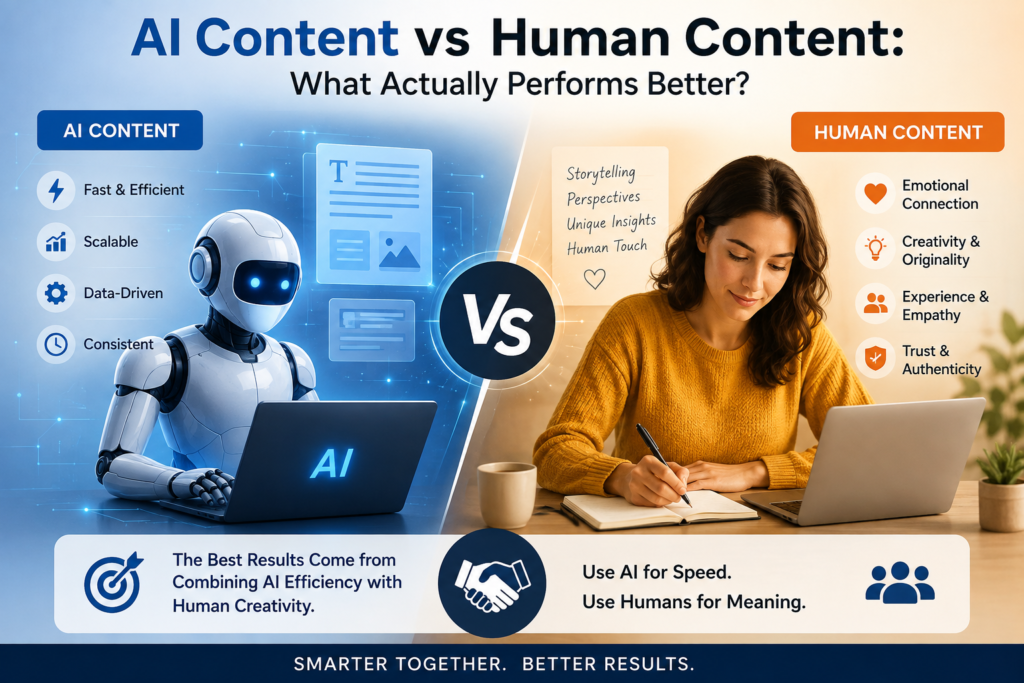
Artificial intelligence has changed the way content is created. From blog posts and social media captions to product descriptions and email campaigns, AI tools can produce content within seconds. At the same time, human writers continue to bring creativity, experience, emotion, and originality that machines cannot fully replicate.
This raises an important question: AI content vs human content—which one actually performs better?
The answer is not as simple as choosing one over the other. In today’s digital marketing landscape, the strongest content often combines the efficiency of AI with the creativity and expertise of humans.
What Is AI Content?
AI content is written or generated with the help of artificial intelligence tools. These tools analyze patterns in large amounts of information and use them to produce text based on a user’s instructions.
AI can help marketers create blog outlines, social media posts, product descriptions, headlines, email drafts, and even long-form articles. Its biggest advantage is speed. A task that might take a writer several hours can often be completed by AI in minutes.
AI is also useful for brainstorming ideas, researching topics, improving grammar, summarizing information, and creating multiple versions of the same message.
However, AI-generated content can sometimes feel repetitive, predictable, or generic. Without human editing and direction, it may lack personal experience, emotional depth, and a distinctive brand voice.
What Is Human Content?
Human content is created by writers, marketers, journalists, experts, or creators using their own knowledge, experience, research, and creativity.
One of the biggest strengths of human-written content is its ability to connect with readers on an emotional level. Humans understand personal experiences, cultural context, humor, opinions, and subtle emotions in ways that automated systems may not always capture.
For example, a travel writer who has personally visited a destination can share practical observations, unexpected experiences, and personal recommendations. These details can make an article much more useful and engaging than a generic description generated from existing information.
Human content can also establish trust because it can demonstrate genuine expertise and first-hand experience.
Which Performs Better for SEO?
SEO performance depends on much more than whether content was written by AI or a human.
Search engines increasingly focus on content quality, relevance, usefulness, originality, and whether a page satisfies the user’s search intent. Simply producing large amounts of AI-generated text does not guarantee better rankings.
AI can be extremely useful for SEO. It can help identify content ideas, organize topics, generate outlines, suggest keywords, and speed up the writing process. However, publishing AI content without fact-checking, editing, or adding unique value can result in content that provides little benefit to readers.
Human involvement is particularly important when a topic requires expertise, original research, personal experience, or strong opinions.
The best approach is therefore not “AI versus human.” It is AI plus human expertise.
Where AI Content Performs Better
AI has several advantages when speed and scale matter.
For businesses producing a large amount of content, AI can significantly reduce the time required for repetitive tasks. It can generate product descriptions, social media ideas, email variations, FAQs, and content outlines quickly.
AI is also useful when marketers need to overcome writer’s block. Instead of starting with a blank page, a writer can ask an AI tool for several ideas and then develop the strongest one.
Another advantage is consistency. AI can help maintain a specific structure, tone, or format across large amounts of content when properly guided.
For routine and repetitive content, AI can therefore be more efficient than traditional writing alone.
Where Human Content Performs Better
Human writers have a major advantage when originality and authenticity are important.
Readers can often recognize when content feels generic. A human writer can add personal stories, real examples, unique opinions, industry insights, and emotional connections that make content memorable.
Human expertise is especially valuable for topics involving professional advice, customer experiences, case studies, interviews, thought leadership, and original research.
Consider two articles about digital marketing. One simply summarizes information already available online. The other includes original campaign results, lessons learned from real projects, expert opinions, and practical examples.
The second article is likely to provide greater value because it offers something readers cannot easily find elsewhere.
What About Engagement?
Engagement depends heavily on relevance and authenticity.
AI can create content that is grammatically correct and well structured, but technically correct writing does not automatically create an emotional connection.
Humans are more likely to understand what makes a story interesting, what motivates an audience, and how to communicate an idea in a relatable way.
That is why human editing remains important even when AI is used during content creation. A writer can take an AI-generated draft and add personality, examples, humor, opinions, and brand-specific insights.
The result can be faster to produce while still sounding natural and authentic.
The Winning Strategy: Human + AI
Instead of treating AI and human writers as competitors, businesses should consider them as complementary tools.
AI can handle time-consuming tasks such as brainstorming, outlining, summarizing, research assistance, and first drafts. Humans can then focus on strategy, fact-checking, storytelling, creativity, expertise, and final editing.
A practical workflow could look like this:
Step 1: Choose the audience and search intent.
Step 2: Use AI to brainstorm topics and create an outline.
Step 3: Add original research, expert insights, statistics, examples, and experiences.
Step 4: Use AI to improve clarity, structure, and grammar.
Step 5: Have a human review the content for accuracy, originality, tone, and usefulness.
Step 6: Add a strong brand voice and a clear call to action.
This approach combines the speed of technology with the judgment of human creators.
So, What Actually Performs Better?
There is no universal winner.
AI content performs better when speed, scale, and repetitive production are the priorities. Human content performs better when originality, expertise, emotional connection, and first-hand experience are essential.
But the strongest content strategy combines both.
AI should not replace human creativity. Instead, it should remove some of the repetitive work so writers and marketers can spend more time on ideas that require genuine human thinking.
The future of content marketing is unlikely to be completely AI-generated or completely human-written. It will be a collaborative process in which AI provides efficiency while humans provide purpose, personality, expertise, and originality.
Conclusion
The debate over AI content vs human content is ultimately the wrong question. The more useful question is: How can businesses use AI without losing the human qualities that make content valuable?
AI can help create content faster, but humans make content meaningful.
When businesses combine AI efficiency with human creativity, experience, and editorial judgment, they can produce content that is not only faster to create but also more useful, engaging, trustworthy, and memorable.
In 2026 and beyond, the brands that perform best will not necessarily be those that produce the most content. They will be the ones that use technology intelligently while keeping the human element at the center of their content strategy.